


Countries
Japan
Finnish Lapland E-Book: our complete guide for a magical trip
Posted on
5/9/2026

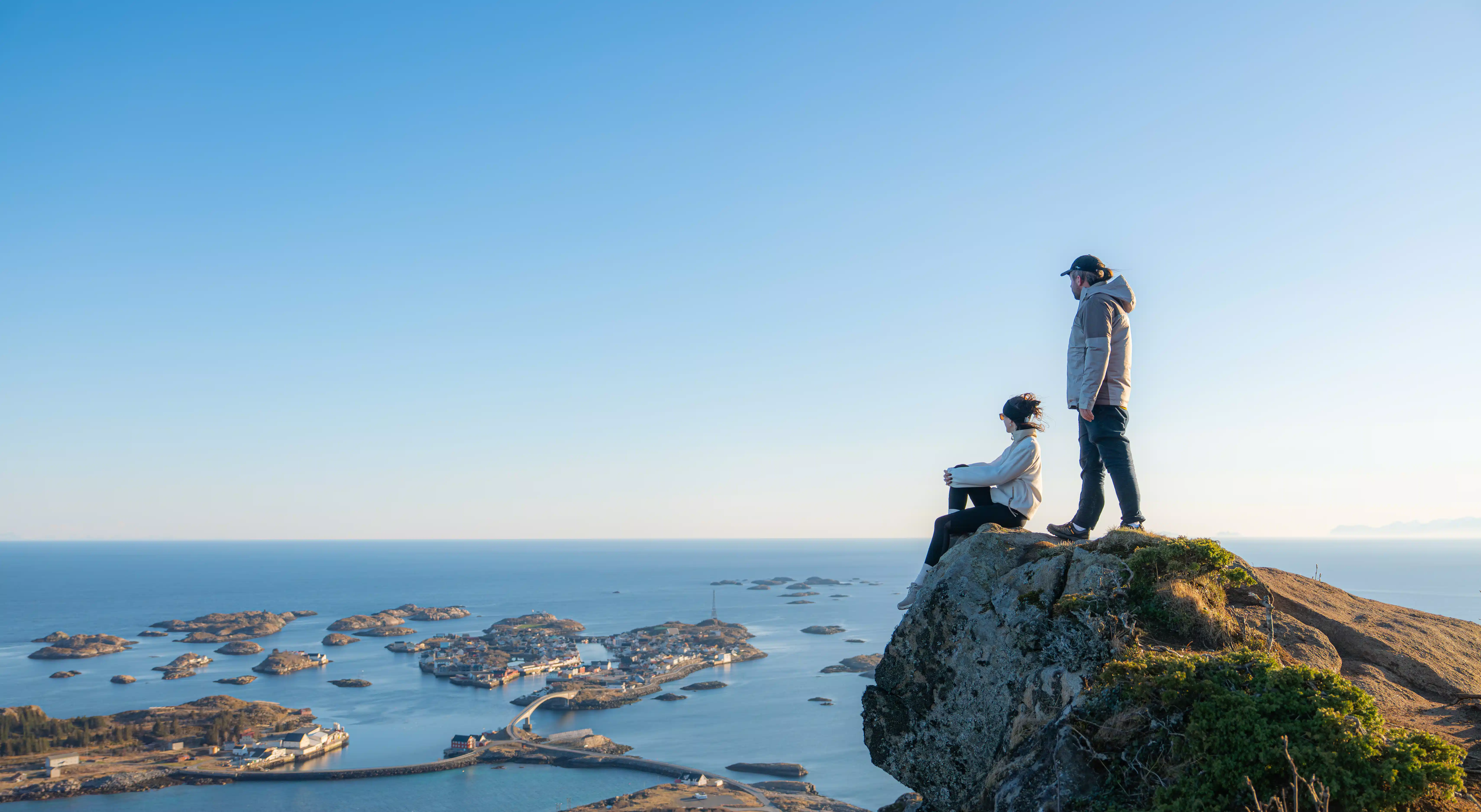
Last April, Simon and I went back to the Lofoten for a 15-day van road trip. This time we widened the loop and added the Vesterålen, just to the north, plus Bodø and the whole coastline on the way back up to Narvik-Harstad airport. Here we're sharing all our tips, our itinerary and our favourites to give you a bit of inspiration.
And if you want more detailed info to plan your own trip, we really recommend taking a look at our E-Book: it's super detailed, packed with recommendations and good tips (and even 3 ready-to-go itineraries), and it'll save you a huge amount of time on the planning.
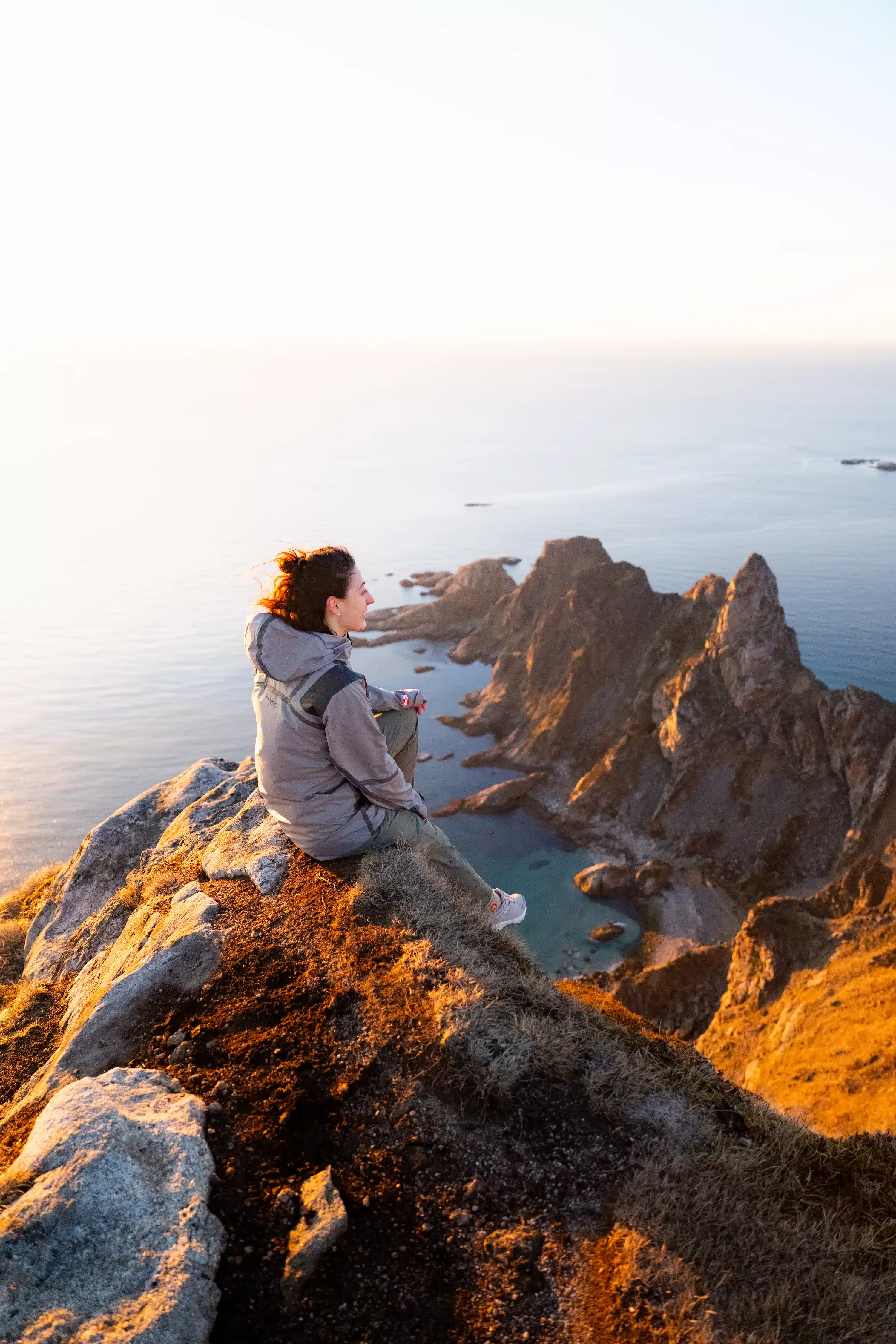
Because it's simply stunning — and that's putting it mildly.
The jagged mountains plunging straight into the sea make the scenery absolutely exceptional. It's wild and grandiose. You can line up loads of activities, there are hikes galore (for every level), and honestly, everything is gorgeous up there. There are the must-sees, of course, but also plenty of quieter spots and trails that are every bit as beautiful.
Not to mention the fishing villages with their red houses perched over the water, the white-sand beaches, the dizzying peaks and an incredible light. In spring (when we went), the summits can still be snow-capped and the temperatures cool; in summer, you get the midnight sun and its long, soft glow; and in winter, you can even watch the northern lights dancing above the fjords. 💚
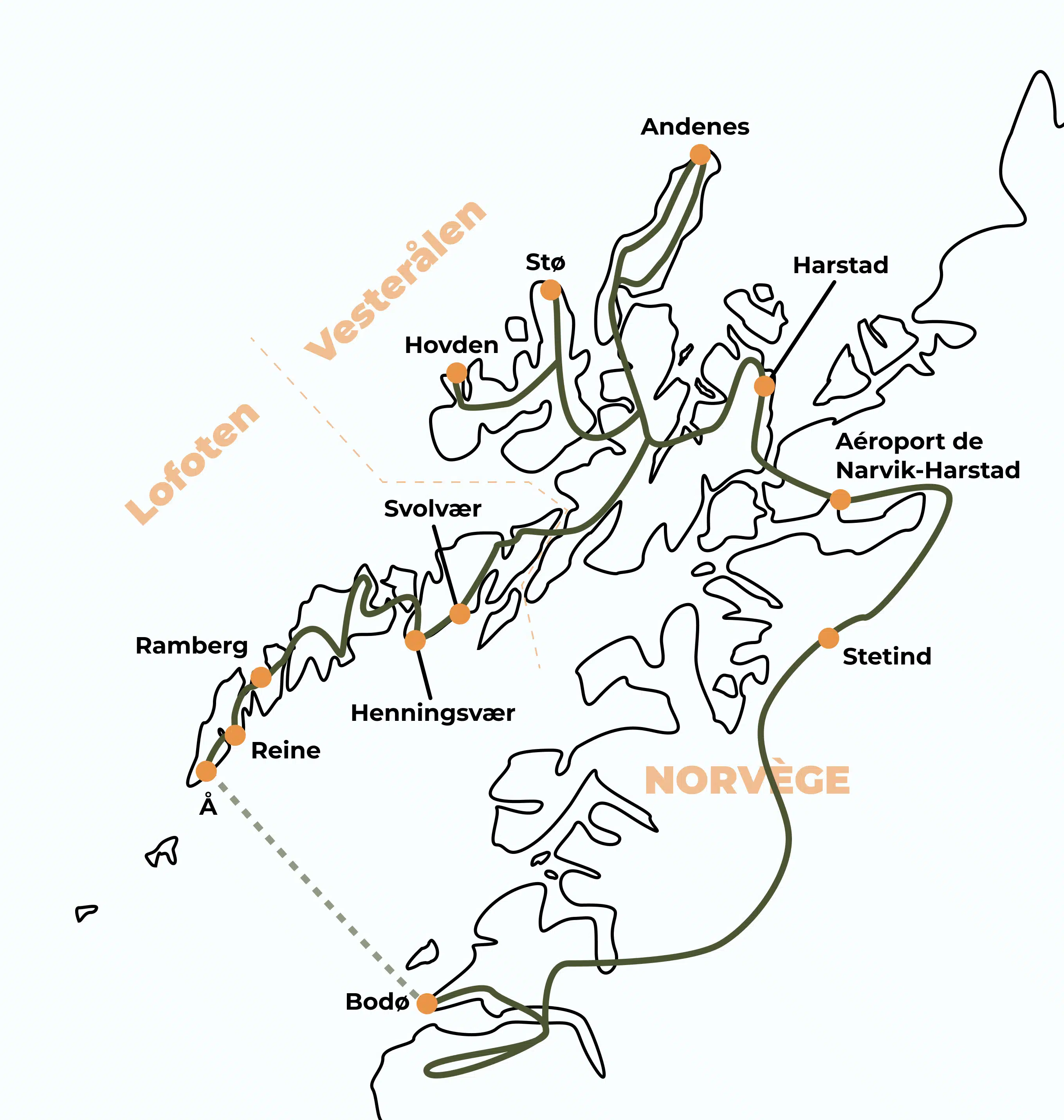
The Lofoten and Vesterålen form an archipelago clinging to the north-west of Norway — a real outcrop of land and mountains reaching out into the Norwegian Sea, entirely above the Arctic Circle. The whole chain stretches around 175 km, like a long string of islands linked by bridges and tunnels.
Here, it's the glaciers that shaped this landscape of deep, narrow fjords — Norway has more than 1,000 of them, making it the country with the most fjords in the world. The Vesterålen extend the Lofoten just to the north: gentler, wilder and far less visited.
In 2 weeks, we were able to do a big loop of the region. Here's our 15-day itinerary in broad strokes, with our favourites:
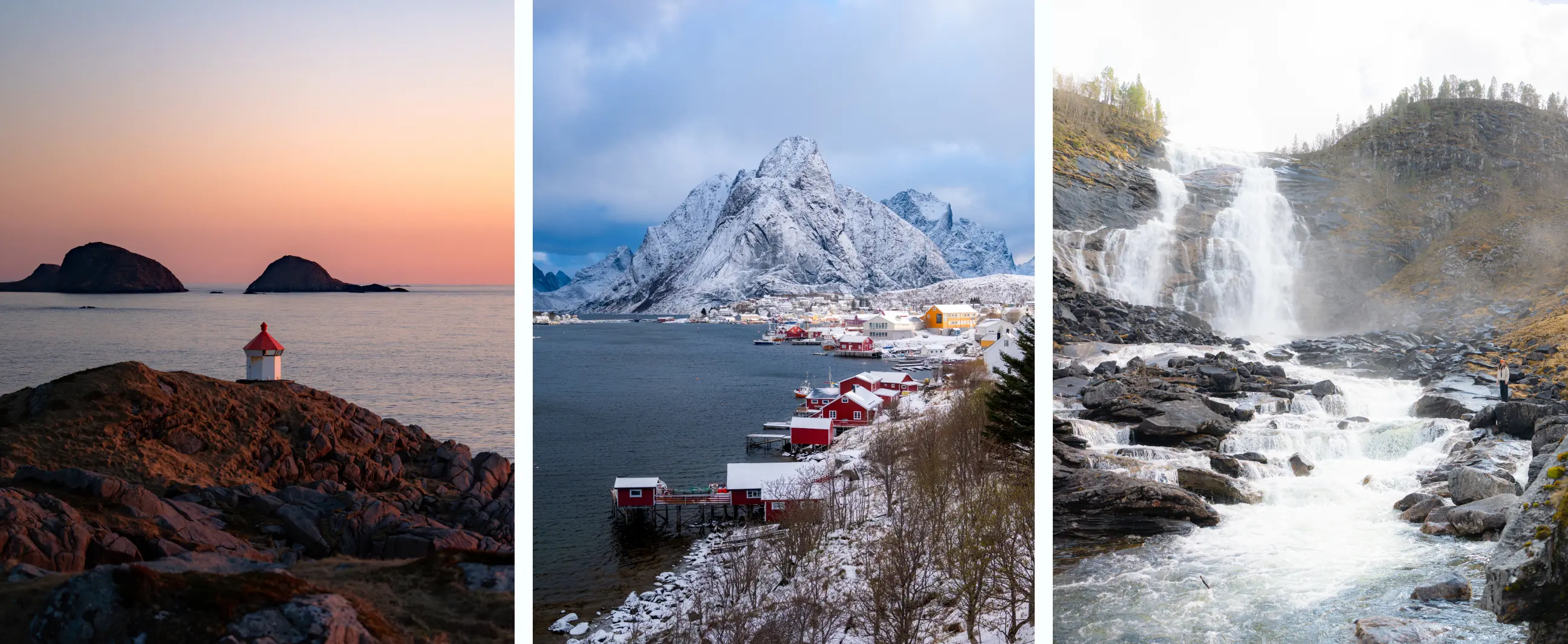
This itinerary takes in the classics while also making time to dig deeper and explore lesser-known, less touristy spots. Depending on how much time you have, you can adapt the trip and pick the area — or areas — you'd like to visit.
As for activities, we mostly went hiking, had a sauna with a view ❤️ and took a cruise in the Trollfjord. But you can also go kayaking, fishing, surfing, watch the wildlife… and much more. And a big bonus: in winter, you can see the northern lights, which makes the trip even more magical! 💚
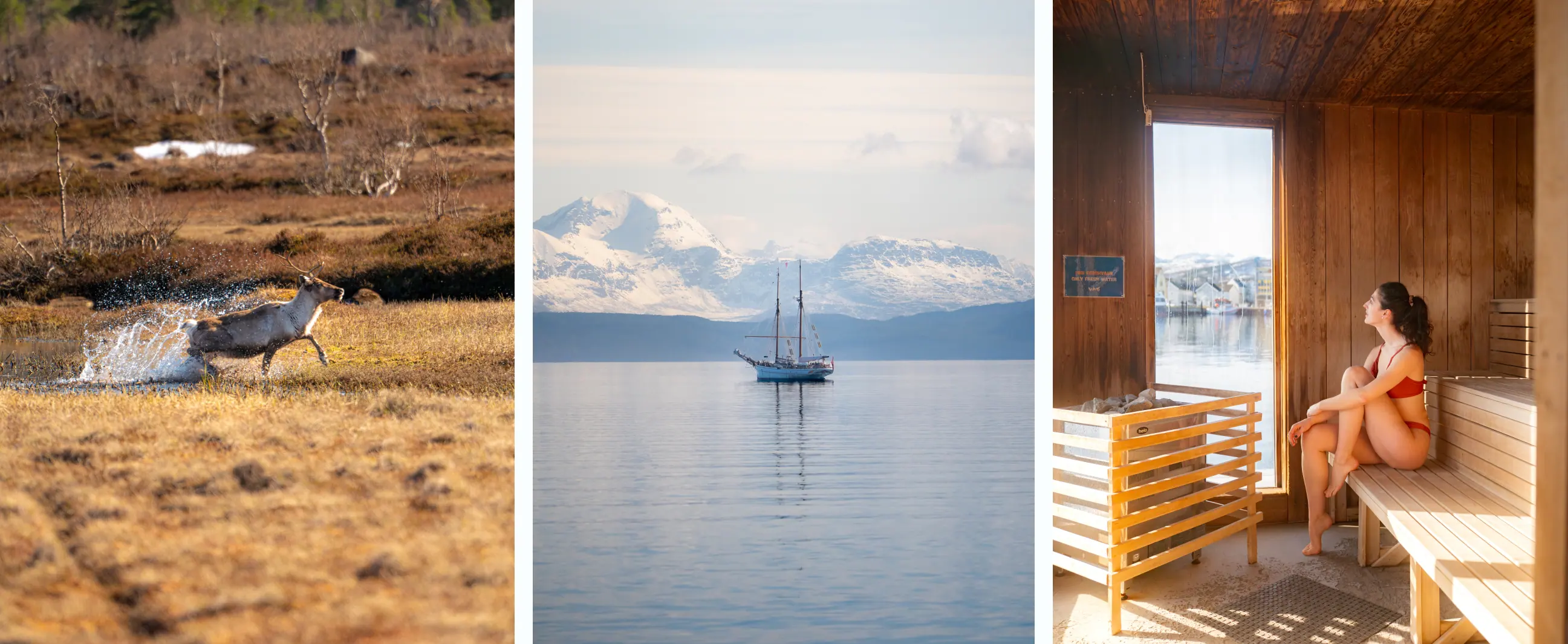
We share our favourite addresses in our E-Book, with discount codes on some activities to help bring down the cost of this trip — which, let's be honest, can add up fast!
Every season has its own vibe, and each one is worth it. That said, no false hopes: you need to know that you can't see the midnight sun and the northern lights on the same trip. It'll be one or the other! (Which might actually help you decide.)
To sum up:
From France, it comes down to flying: reckon on about 4 hours in the air (with one stopover).
Worth noting that there isn't a single "Lofoten airport", but several gateways, and the right choice mostly depends on your dates, your budget and how long you're staying:
Our advice: compare the prices of both flights (on Ulysse, Expedia or Kayak) and rentals (DiscoverCars for cars, or Artic Vanlife for vans) for each airport. The winning combo changes fast from one airport and one season to another.
A few pointers for booking at the best price:
We travelled from 15 to 29 April 2026, with Norwegian, booking barely 2 months ahead: it came to €700 for the two of us, with a single checked bag between us. Book earlier and you can definitely find cheaper.
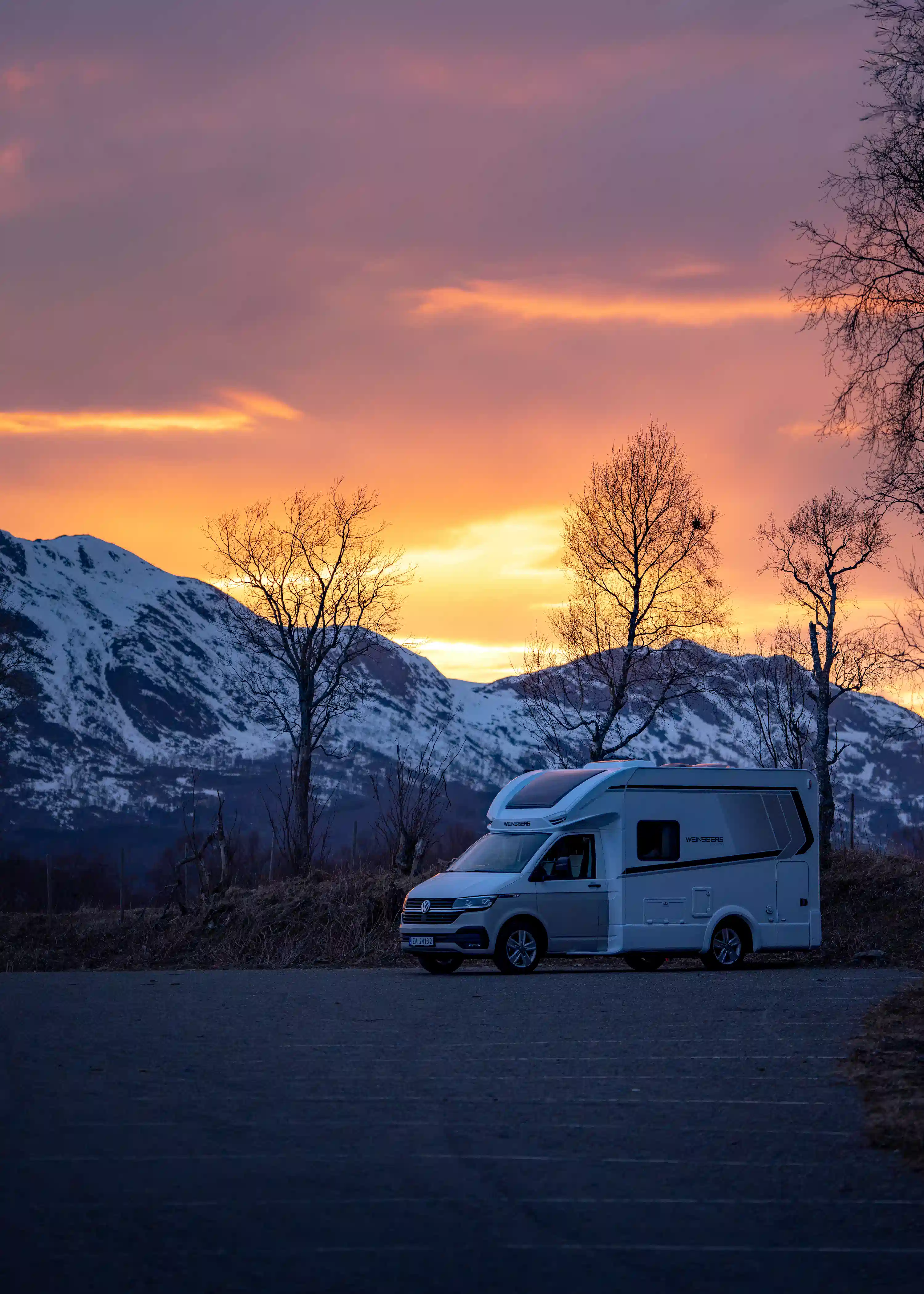
It depends on what you're after, because it isn't cheap. But for us, it's the best way to roam at your own pace and feel free. We actually had to adjust our itinerary quite a bit because of the weather — and in those moments, it's really handy not to be tied to a booked accommodation.
We went through Arctic Vanlife, and we were lucky enough to collaborate with them (they gave us the rental in exchange for content on Instagram). To give you an idea, the rental came to nearly €3,800 for 2 weeks, i.e. around €250/night. That may sound like a lot… but when you know that accommodation can easily top €250/night in the Lofoten, it actually stacks up (and it also saves you the cost of a car rental).
As a bonus, you can cook in the van, and so save a decent amount on restaurant meals (where the bill easily hits €80–100 for two, without even trying).
And travelling by campervan up there is honestly really doable! We'd still recommend going in low or shoulder season, though: in summer it's packed, it can get tricky on the roads (especially the narrowest ones), and it's harder to find a quiet spot to park up. Comfort-wise, we had heating, so no issues with the cold (just as well, because even in April we got a few snowfalls)!
🏷️ We've got a promo code for the van rental in our E-Book. Just what you need to lighten the biggest item in the budget.
And we want to be clear: our guide isn't only for 100% campervan travellers. We also tested some superb places to stay that we recommend inside it. The 3 itineraries cover every style and every budget, from a van road trip to cosier stays.
The Lofoten (and their surroundings) have a climate that's fairly mild in winter and cool to decent in summer. Thanks to the Gulf Stream, temperatures rarely drop below -10°C in winter (versus -30°C in Finnish Lapland, even though we're at the same latitude!). And in summer, they rarely go above 20°C.
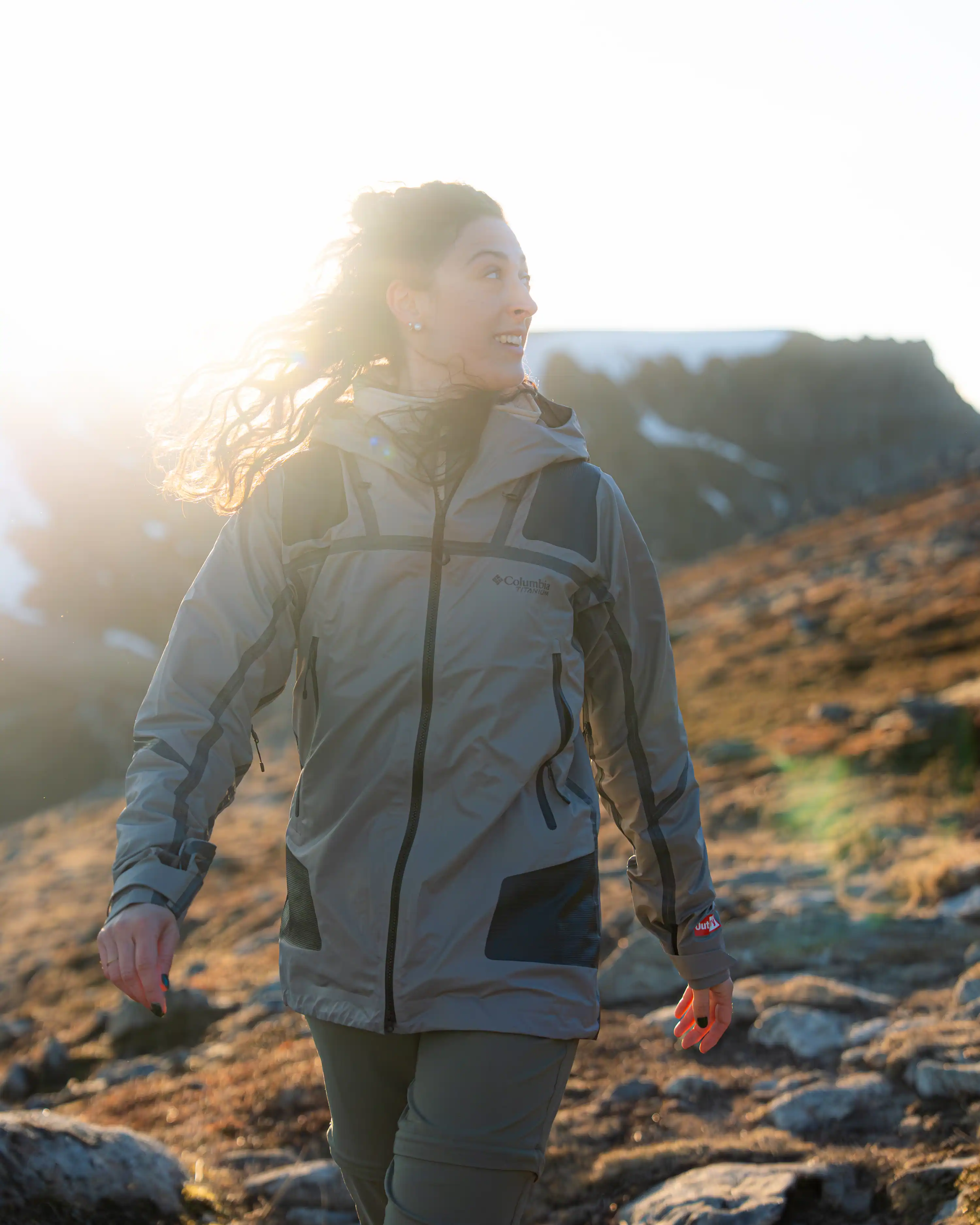
When it comes to gear, rule number one, whatever the season, is to be ready for rain AND wind. Up here the weather changes in the blink of an eye and the wind can be biting, even in the middle of summer.
So whatever the season, we recommend packing waterproof AND windproof clothing. That's the number-one essential, to bring even in summer. We'd also suggest going for the "3-layer" system: a base layer (merino is great), a fleece or light down jacket, then the waterproof-windproof shell. And of course, bring good waterproof hiking boots with proper grip to handle the rain and mud (and even the still-snowy sections).
You can even add a hat, gloves and a neck gaiter, because even in summer the wind on the ridges and summits cools you down fast.
We detail our full kit and checklist in the E-Book, but above all, remember what the Norwegians say: "there's no such thing as bad weather, only bad clothing."
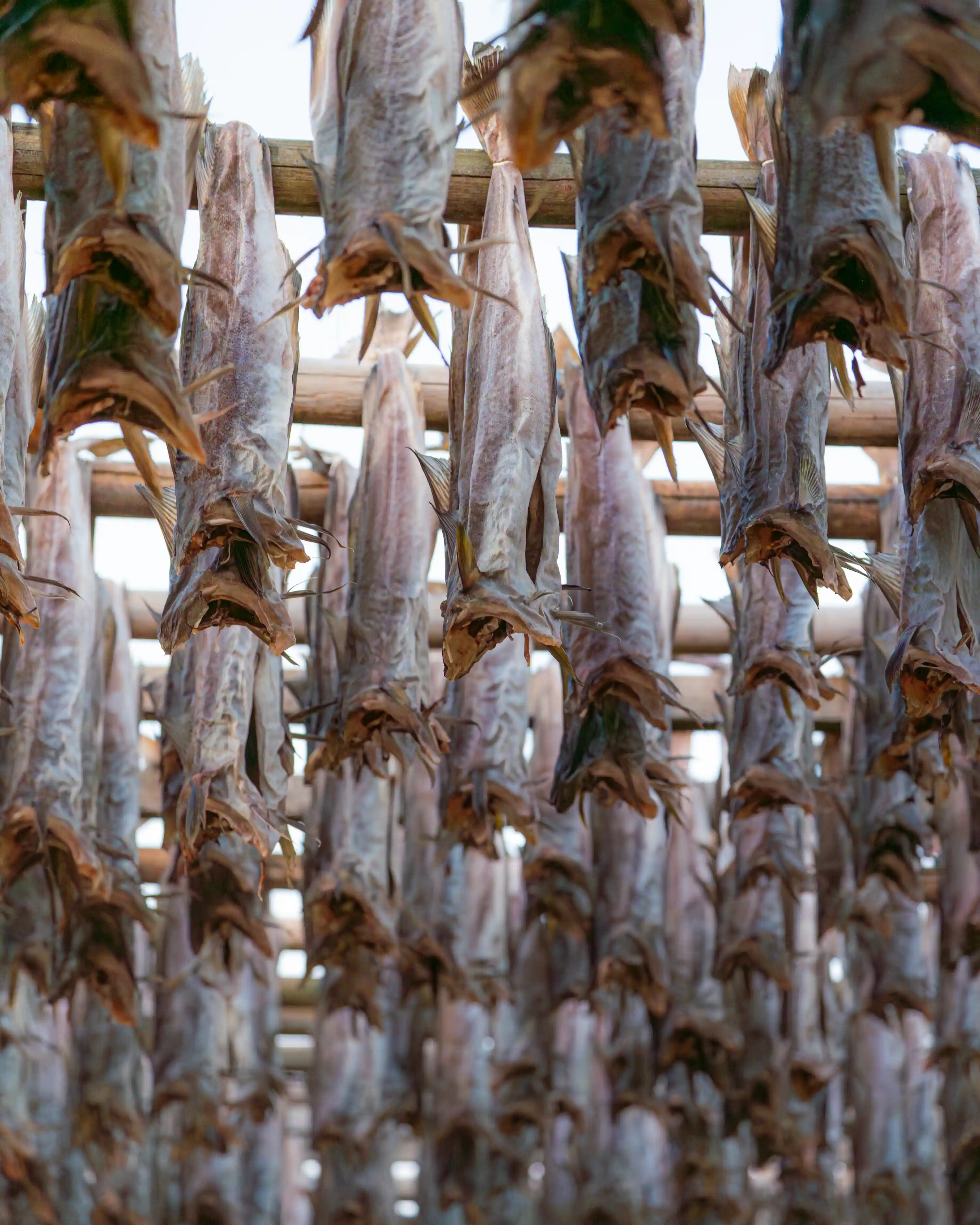
There are a few nice specialities to try (even if, food-wise, it's not exactly a revolution):
Otherwise, to save as much as possible, we recommend doing your shopping at the supermarket (the Kiwi stores are the cheapest).
The Lofoten, the Vesterålen and Bodø are a region we recommend 100%.
Between the mountains diving into the sea, the fishing villages, the unreal beaches, the breathtaking hikes and the freedom of the van, we had our eyes full from morning to night. And even in April, with its lengthening light and still-snowy peaks, it was a great time to make the most of it, far from the summer crowds.
And if you feel a bit overwhelmed by the planning (which is totally normal, between all the research, the bookings and so on), we've created a guide to walk you through it from A to Z, based on our own experience and discoveries, packed with practical tips and recommendations.
🎁 A little gift if you've made it this far: use the code FOXLOFOTEN10 to have -10% on our Lofoten E-Book.
So, are the Lofoten calling your name? Let us know in the comments, and ask us your questions — we'll be happy to answer! 🦊
This trip was made with Arctic Vanlife (who gave us the van rental). As always, our opinion and our experience remain 100% our own.
1️⃣ Keep an eye on the weather, and especially the wind, on yr.no. It's the go-to Norwegian weather app. The wind can be fierce and make some ridge hikes (Reinebringen & co) dangerous or downright impossible — we had to give up on a hike because of the gusts.
2️⃣ Book your van and your rorbuer well in advance. Supply is limited in the area and the best places (like the rorbuer in Reine/Hamnøy) go months ahead, especially in high season.
3️⃣ Everything is paid by card, and tolls/ferries are often automatic (licence-plate reading). You don't need cash in Norway. Just check with your rental company how tolls and some ferries are billed, to avoid surprises when you get back.







How about we chat?